Games and toys have been created for children to play with for as long as humans have been in existence, and children’s books date back to some of the earliest experiments in printing. The first picture book exclusively meant for children is generally accepted to be Orbis Sensualium Pictus [The Visible World in Pictures], published in 1658 by Johann Amos Comenius. In it, Comenius combined text with illustrations to help teach children about the world.

This collection of items from Bernett Rare Books offers something for everyone. We present books, educational materials, and games aimed at children, as well as a trade catalog of toy manufacture, dating from as early as 1814, up through the 1960s, and from locations across Europe and Asia.

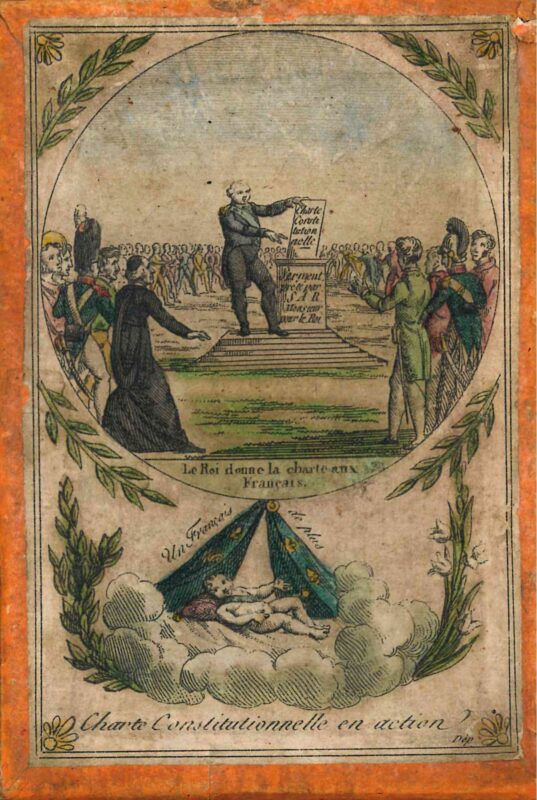
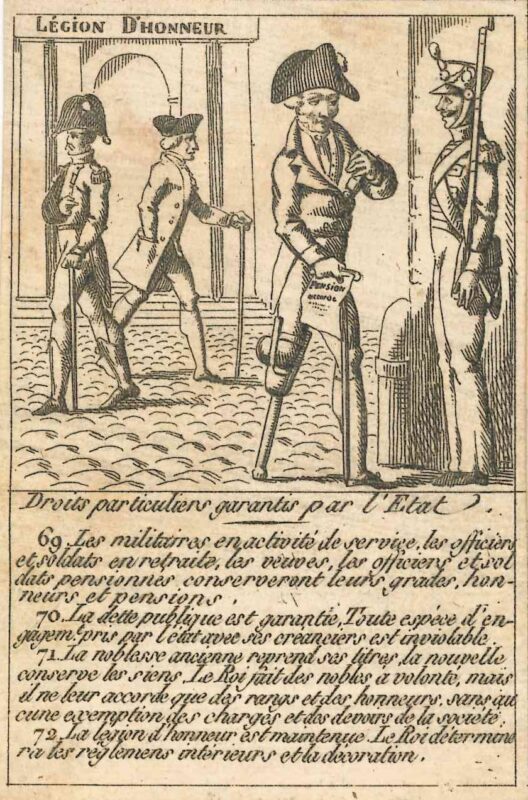
The earliest item in this grouping is a rare set of French historical cards, dedicated to teaching about the Constitutional Charter. The set of 24 cards date from 1814, each with an engraved illustration above several lines of text detailing 2 to 4 of the articles from the Charter, with all 76 articles contained across the 24 cards. This type of series was distributed by the “Marchands de Nouveautés”, a generic name given to a group of print dealers in Paris who usually printed more popular stories such as Robinson Crusoe or Don Quixote. A set of cards such as this one was intended to help eliminate Napoleonic fervor and unite France under a renewed sympathy for and belief in the monarchy. A very scarce set in its original cardboard box with engraved and hand-colored vignette to lid.
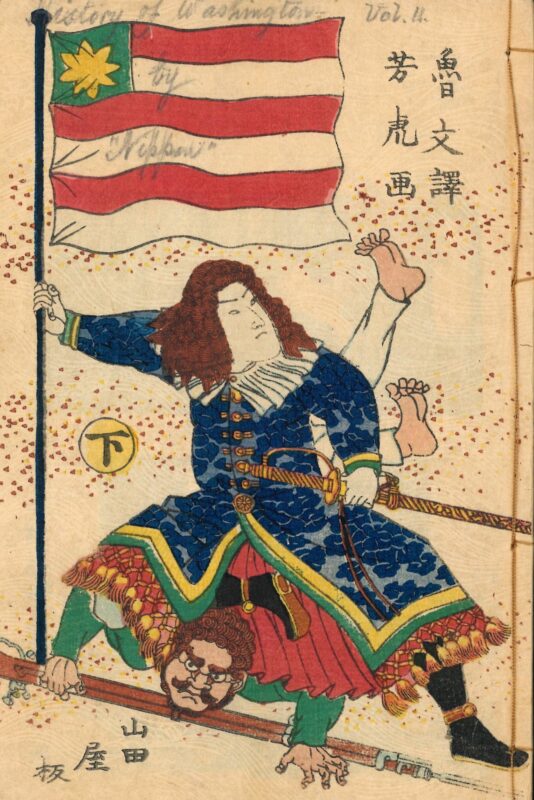


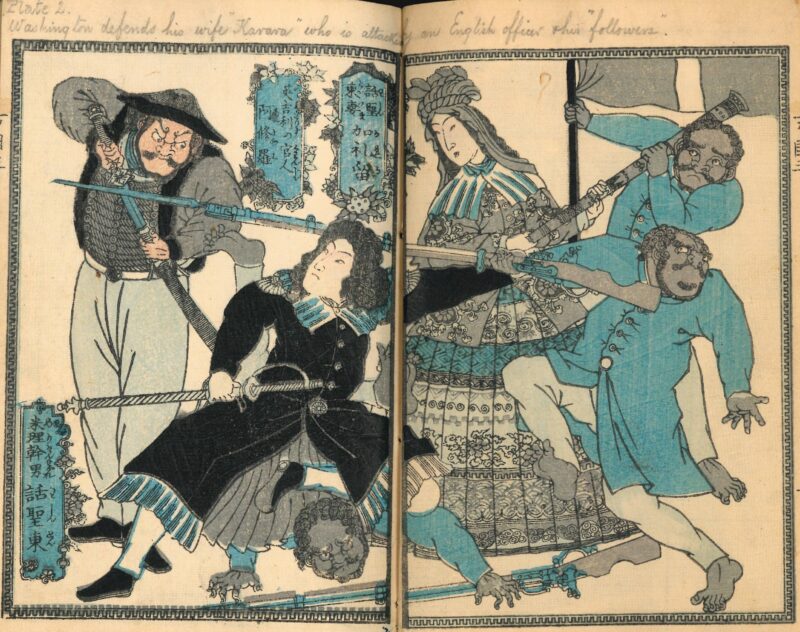
The second item is a whimsical and bizarre illustrated alternative American history from Japan called Osanaetoki Bankokubanashi. Dating to 1861, this unusual and rare set of four booklets translate loosely as “The History of Washington”. Written by Kanagaki Robun and illustrated by Utagawa Yoshitora, this fascinating series describes and depicts scenes where Christopher Columbus discovers America and defeats mutineers, but then shows George Washington, John Adams, and Benjamin Franklin as superhero-like figures who punch tigers, defeat dragons, and kill giant snakes who eat people. This set was issued shortly after Commodore Perry’s arrival in Japan, when interest in America was high but direct experience with America was still virtually non-existent – and so Japanese writers could imagine up fantastical tales and visions of grotesque monsters, evil villains, and peaceful goddesses existing in that exotic land.


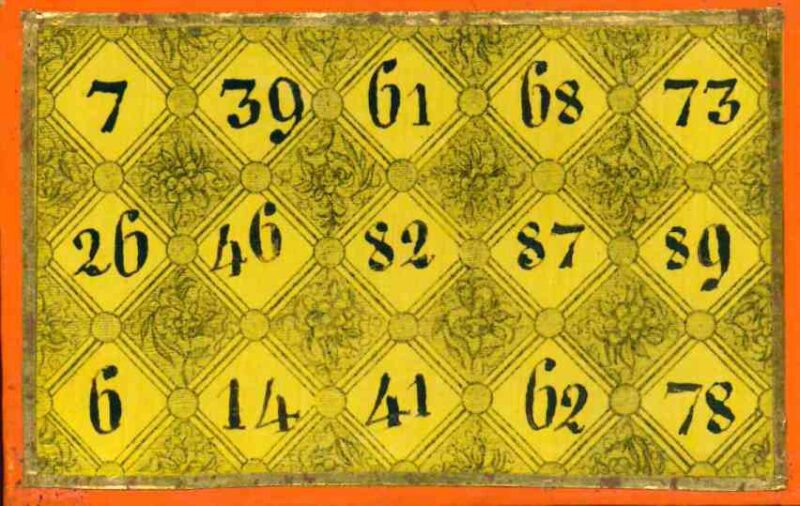
The third object which also dates most likely to the 19th century is an antique ‘tombola’ game from Italy. ‘Tombola’ is a traditional Italian game very similar to bingo, first played in Naples in the 18th century. This set is comprised of a cardboard game board with 90 gold-numbered spaces on red paper in an embossed gold paper frame, 90 hand-numbered wooden game tokens, and 87 total individual cards in 15 sets, the cards also hand-numbered. Traditionally, players would cover the numbers on their individual cards using beans, lentils, or pieces of citrus peel as markers.
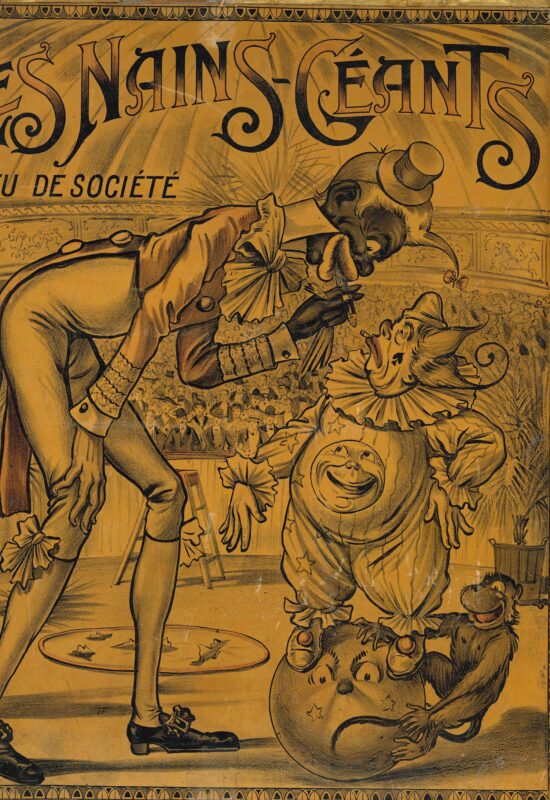


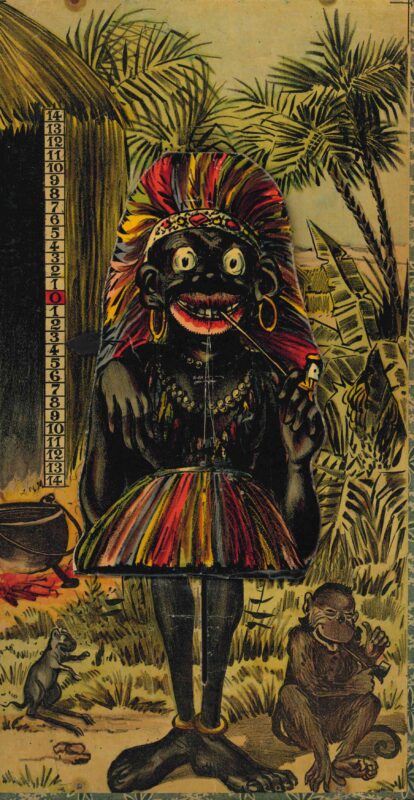
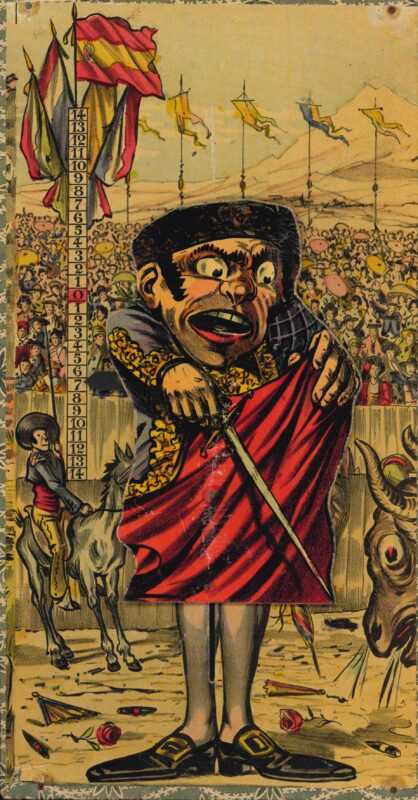
Our fourth object is a larger-format board game dating to right around the turn-of-the-century. Titled ‘Les Nains-Géants’, or ‘The Dwarf Giants’, this humorous game has players keep track of their points using a large chromolithographed caricature-style figure which slide up and down along a scoring track, making the figures ‘grow’ and ‘shrink’. Whoever reaches the top of their tracker first wins the game. The characters in the game include a jockey, a postman, a matador, a farmer, a soldier, and a “tribal” style Black man in front of a hut. The box lid also includes a racial stereotype in its cover illustration depiction of a Black man and a circus clown. The game was published by Saussine, a well-known Parisian game manufacturer, and was designed by Eugene Serre, one of Saussine’s greatest illustrators.
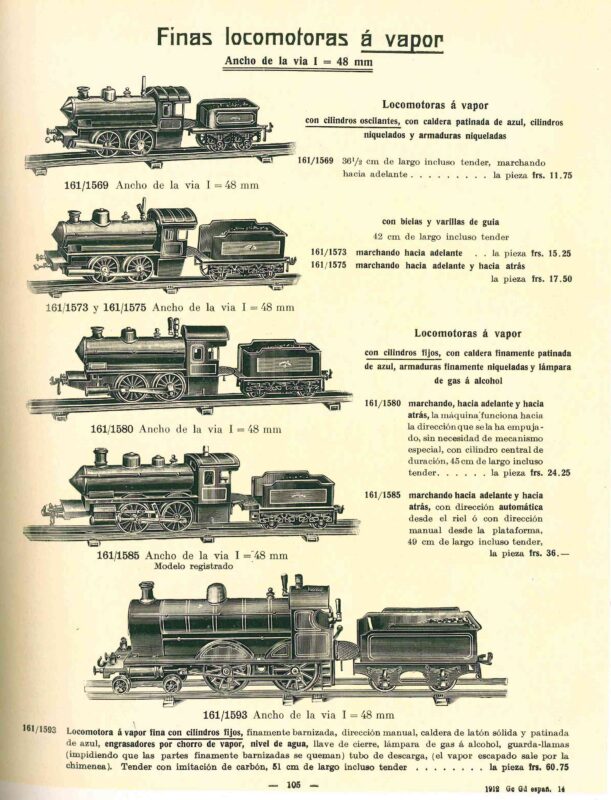


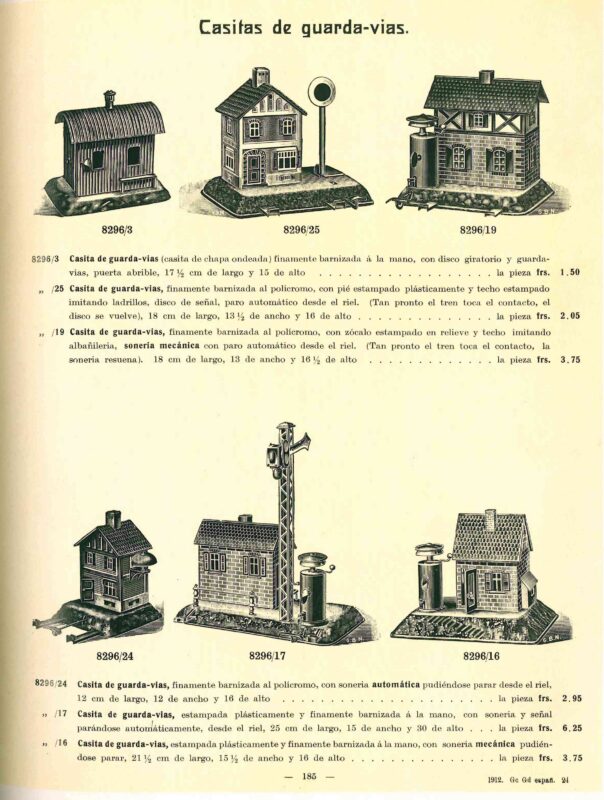
Moving into the 20th century, we have this scarce trade catalog of German toys for the Spanish market. The catalog was printed in Nuremberg in 1912 for Gebrüder Bing, a German toy company founded in 1863 which started their business producing metal tableware and utensils before moving to toy production. They ended up becoming best-known for their toy trains and live steam engines. This particular catalog covers a wide range of their offerings and provides detailed descriptions, measurements, and prices of toys such as steam engines, steam trains, ships, automobiles, train tracks, train set accessories, magic lanterns, and steroscopes.
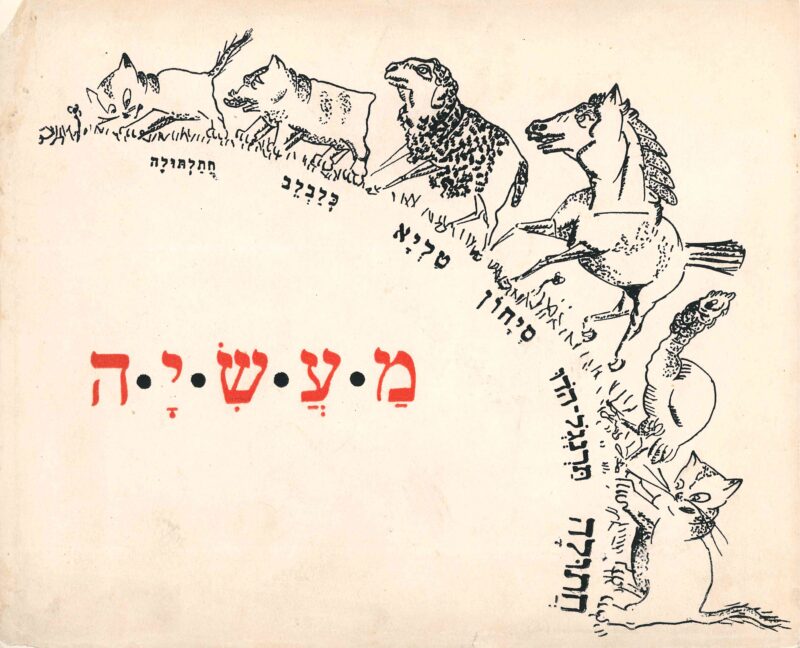
 

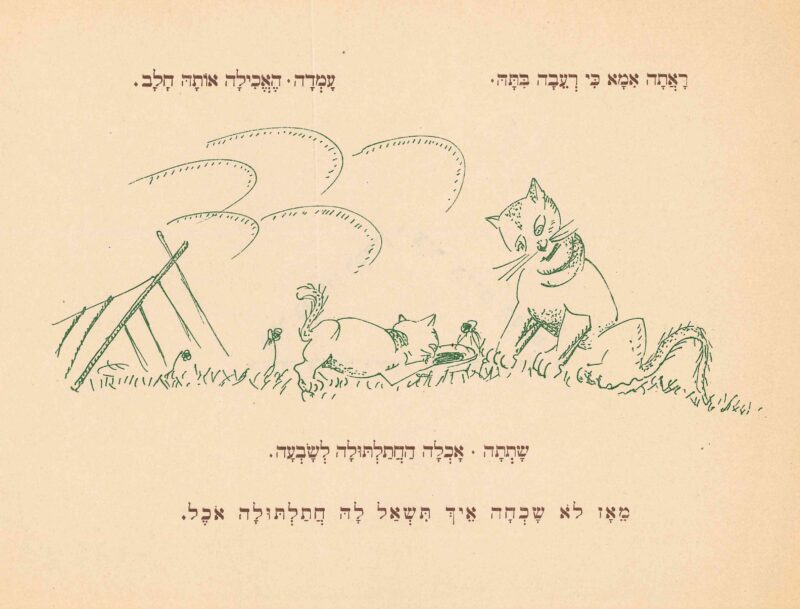
Next up are a few various items dating to the 1920s. The first of these is a rare Hebrew-language children’s book published in Warsaw around 1922. The book was written by Bentsiyon Raskin (also known as Ben Zion Raskin), one of the leaders of the Zionist movement in Warsaw, and illustrated by Chaim Hanft, a member of the Warsaw School of Fine Arts. The book tells the story of a kitten who played with other animals until she grew hungry, and realized she had forgotten how to ask for food. It was published as part of Raskin’s “Zil Zlil” series of five children’s books.
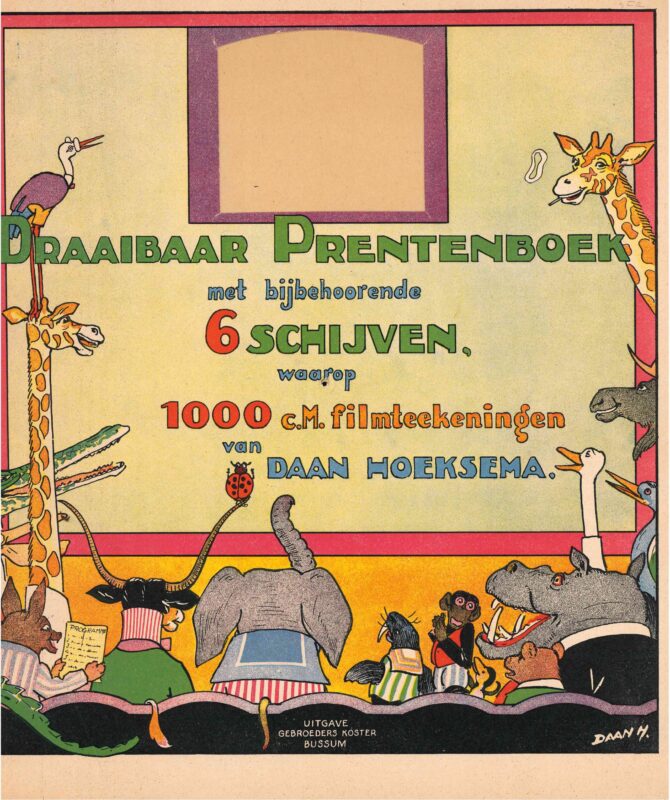
 

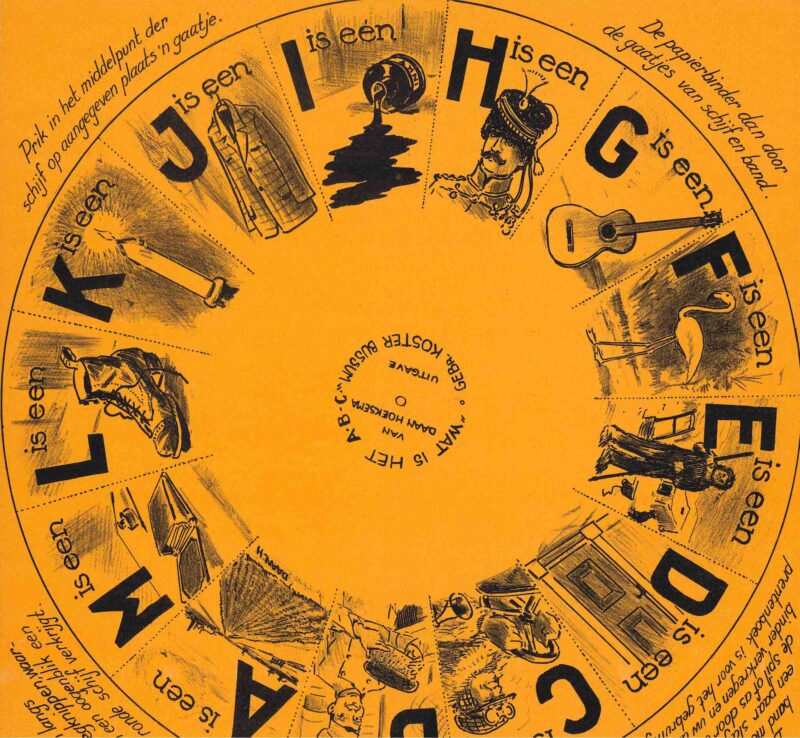
The next object is a Dutch moveable children’s picture book, a sort of precursor to early animation, dating to 1924. It was designed by Daan Hoeksema, a noted Dutch children’s book illustrator and graphic designer who wrote what is considered by many to be the first locally-produced Dutch comic book with an ongoing storyline and recurring main character. This rare ‘book’, titled ‘Draaibaar Prentenboek met bijbehoorende 6 schijven, wwarop 100 c.m. filmteekeningen’, consists of six sheets of cardstock with illustrations drawn around a circle. The sheets contain instructions for cutting out the discs and securing them through the center with a brad, allowing the viewer to rotate the disc and see a sequential story or series of images, a sort of moving comic book. The discs contain images and stories including an alphabet, the adventures of two traditional Dutch villagers, racist stereotypes of Black people in Africa, moral tales, and silhouettes of circus performers, among others.


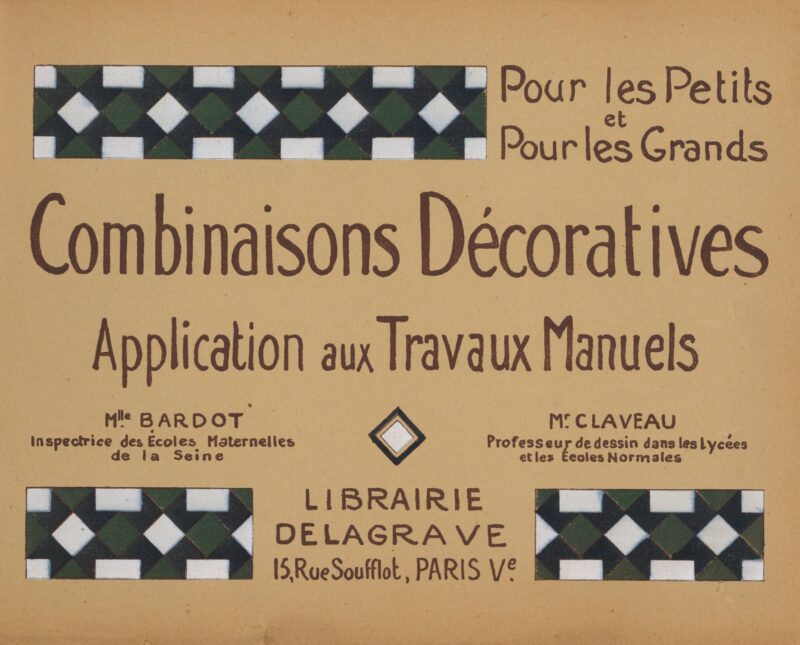
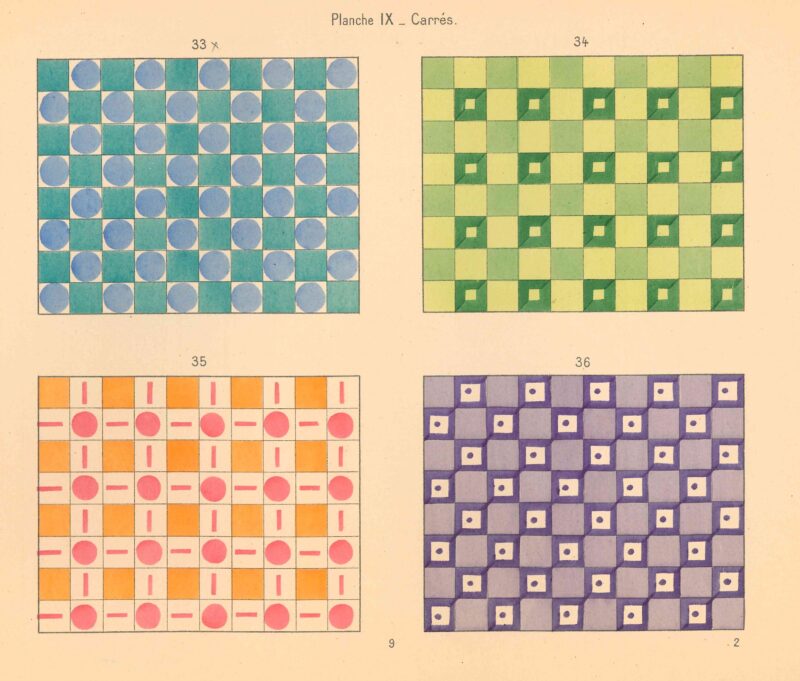
The last item dating to the 1920s is a French early childhood art education manual with 16 original brightly colored pochoir plates. Combinaison Décoratives: Application aux Travaux Manuels, Pour les Petits et Pour les Grands was published in Paris in 1929 as a method for teaching color composition to children. The plates show numerous decorative patterns which were executed by young schoolchildren between the ages of 4 and 8. One of the authors, Madeleine Bardot, served as Inspectrice des Écoles Maternelles de la Seine and was an advocate of “l’education nouvelle”, a movement which, in their words, “prepared children not only to become future citizens capable of fulfilling their duties towards their loved ones and humanity as a whole, but also human beings conscious of their human dignity.” The other author, M. Claveau, was a professor of drawing at the lycées and écoles normales. Together the two selected 64 pieces from the best examples of student work. Many of the outlines were prepared by teachers and filled in by students, but the last few plates were created entirely by children from start to finish. A beautiful work of early childhood education and also color theory.
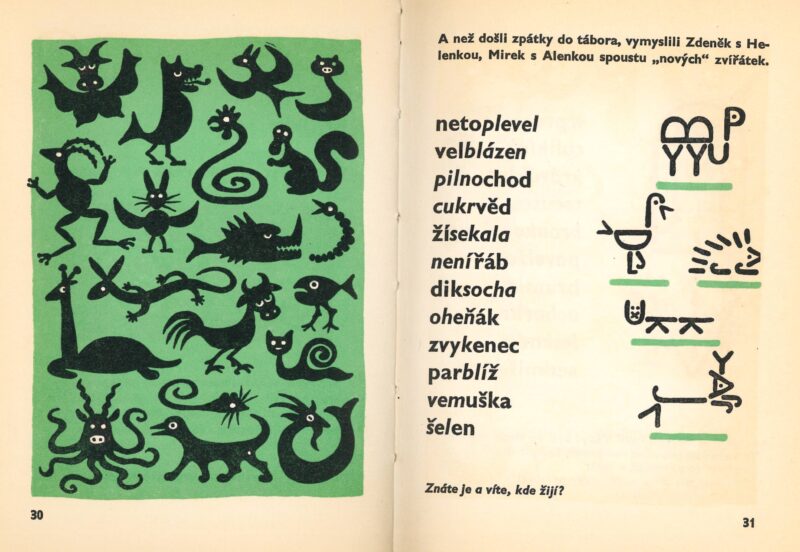


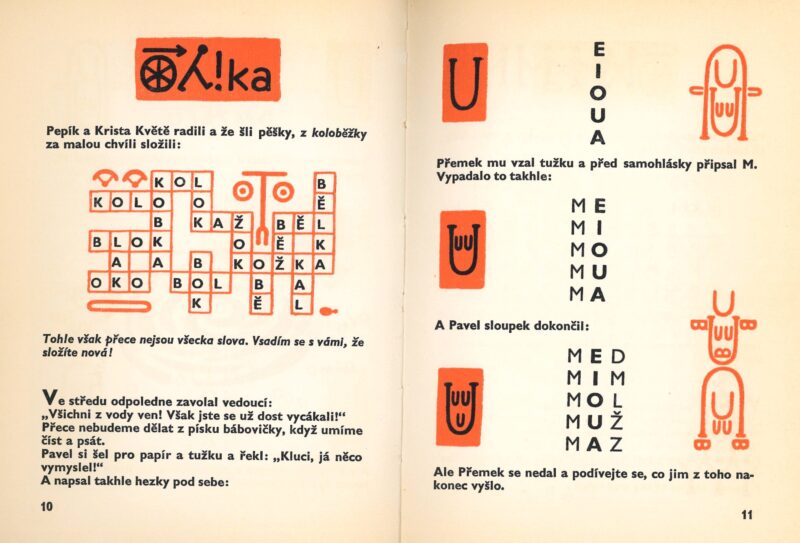
The final item in this collection is a quirky work of Czech concrete poetry designed as a whimsical children’s book. Co se slovy všechno poví was published in 1964 and contains poems by Josef Hirsal and Bohumila Grögerová, foremost representatives of concrete and experimental poetry in mid-century Czechoslovakia. With illustrations by Věra and Pavel Brázda, the book is a playful exploration of word-based games that children play on a train ride, full of visual poems, full-page colorful illustrations, and two-color letterpress designs set by Josef Dolezal.
 

We welcome inquiries on any of the above items, and wish you all a very happy and healthy holiday season!

{ 1 comment }

In an introduction to the first issue of the Boston-based music magazine Frenzy, editor Robert Alan Colby wrote, “In increasing numbers, rock fans all over the world have had it with…so-called “rock” that doesn’t rock, and with the whole “superstar” set up and the jaded, bored multi-millionaires it’s elevated. They want something new…and to get what the music industry won’t give them, they’ve gone elsewhere, to little clubs and basement dives, to groups that still know what rock ‘n’ roll is supposed to be about.”

The period from the late 1970s through the early 1990s demonstrated a rise in regional music publications which showcased the growing local music scene in their hometowns as well as covering bigger mainstream names which were becoming popular nationwide. These music hot spots popped up from coast to coast, and music lovers and editors jumped on the bandwagon, creating a number of short-lived magazines which capitalized on the post-punk and rock and roll revolution taking place in the United States. Here at Bernett Rare Books, we currently have in our inventory quite a remarkable collection of these rare music and related pop culture magazines, which provide a sensational overview of the rock & roll and underground scene in late 20th century America.


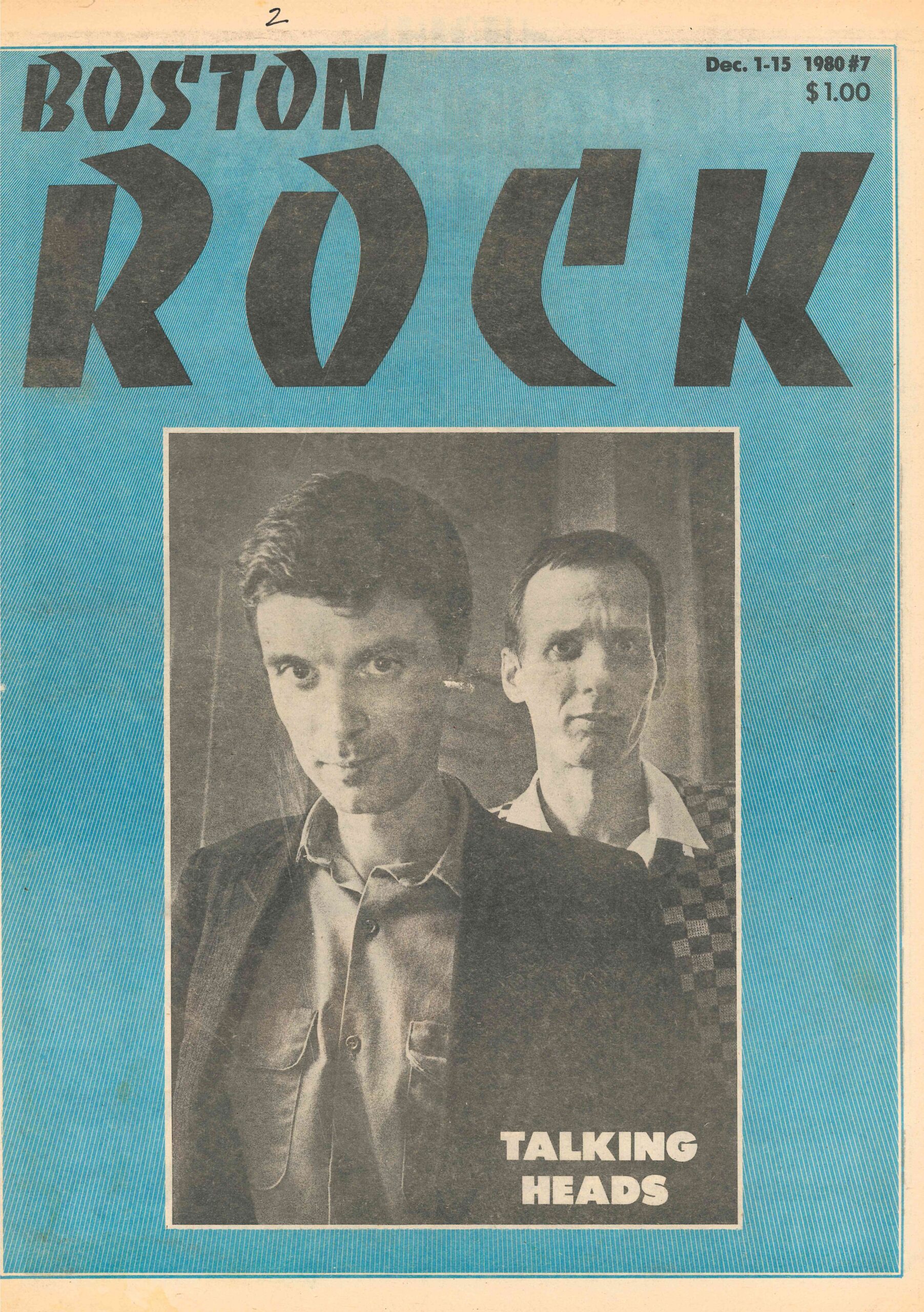
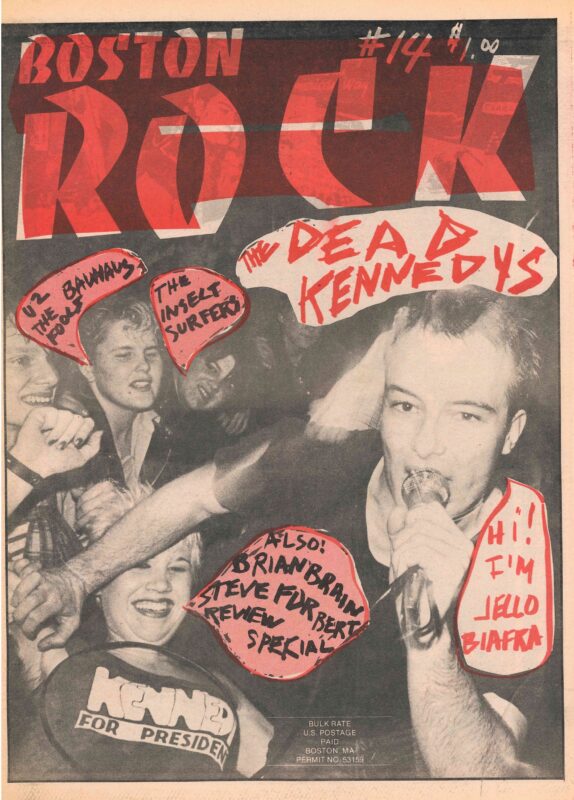
The first of these is Boston Rock, a seminal 1980s publication founded and published by Mike Dreese, the founder of Newbury Comics. He started the business in 1978 and began offering music when a friend brought him his record collection to sell. Newbury Comics quickly became one of the area’s leading record stores specializing in punk and new wave. In 1980, Dreese founded both Boston Rock magazine and Modern Method Records for local punk bands. The issues contained features and interviews alongside charts and reviews, covering a veritable who’s who of the local and wider punk and rock music scenes, including names such as The Ramones, The Cars, The B-52’s, Psychedelic Furs, the Stranglers, Talking Heads, Dead Kennedys, Elvis Costello, Sting and The Police, U2, Echo and the Bunnymen, The Clash, The Cramps, Human League, Iggy Pop, R.E.M., Peter Gabriel, The Who, Beastie Boys, Grandmaster Flash, and many others. (53425) $4,500


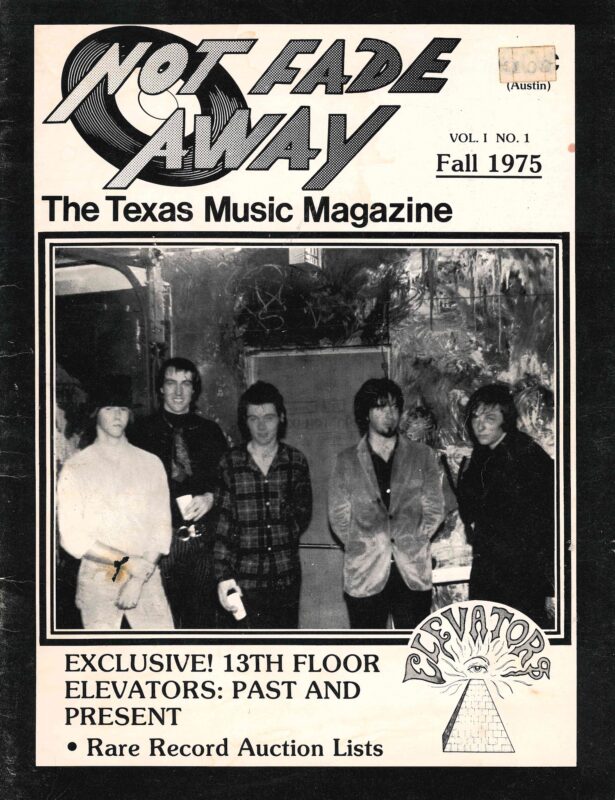
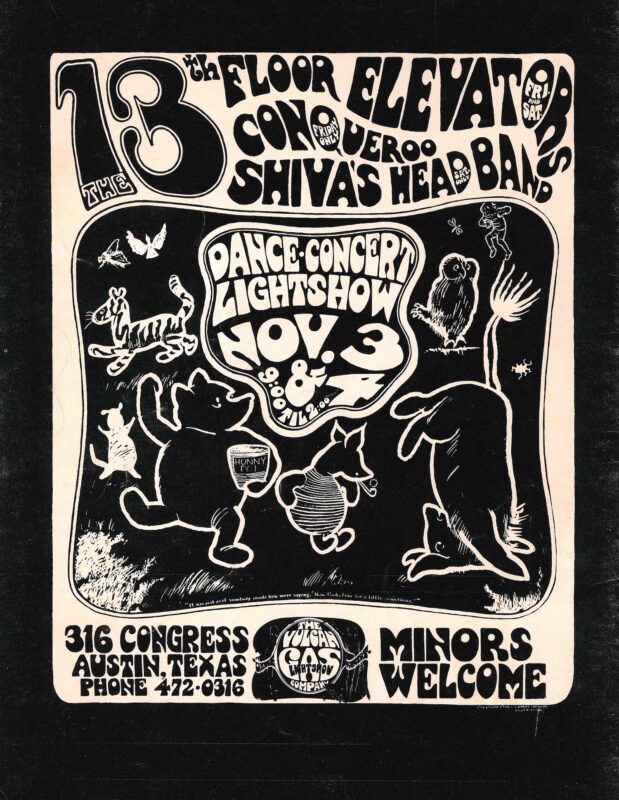
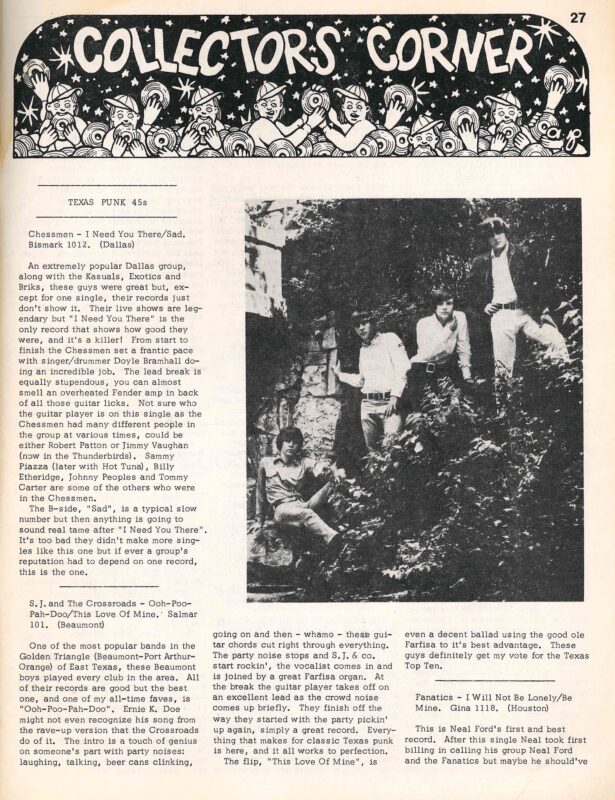
Next up is Not Fade Away, an irregularly-published (only 4 issues in 10 years!) music magazine out of Austin, Texas. The magazine was published by Doug Hanners, a record dealer who founded the Austin Record Convention and Texas Archive, a record label which reissued albums from mostly obscure Texas garage rock and rockabilly bands. The issues of Not Fade Away focused mainly on Texas-based punk and garage rock bands, such as the 13th Floor Elevators, Roky Erickson, Kenny and the Kasuals, Shiva’s Headband, Red Krayola, Mouse and the Traps, The Bad Seeds, The Reasons Why, Larry and the Blue Notes, Lost & Found, the Sparkles, and more. When the second issue came out long after the first, the editor’s note read, “Surprise! Thought you’d seen the last of NFA didn’t ‘cha? Well, for awhile we thought so too. I want to apologize to everyone who has been waiting for this issue and thank you for your patience. We didn’t plan to publish a fanzine every year or so but that’s the way it turned out….I had no idea Texas music was as popular as it is all over the world.” (53396) $1,500


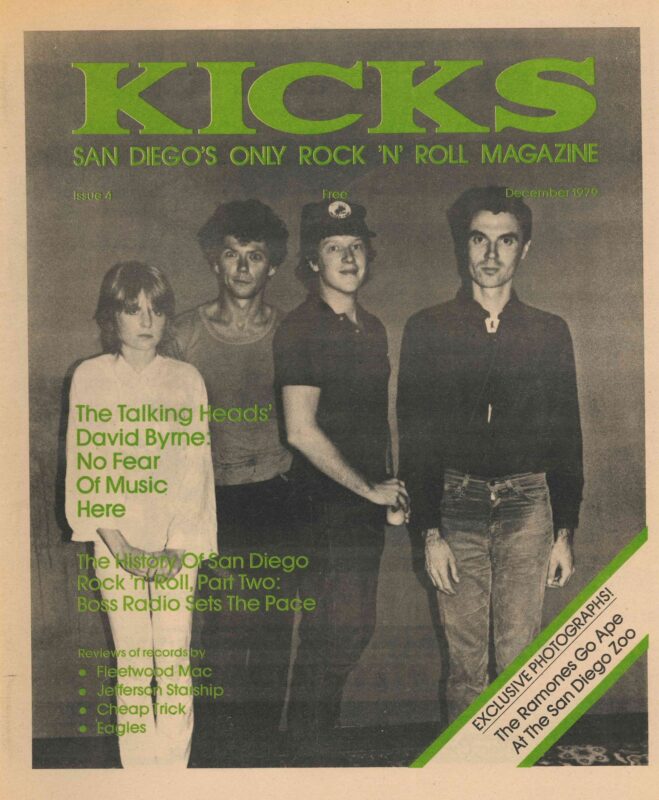
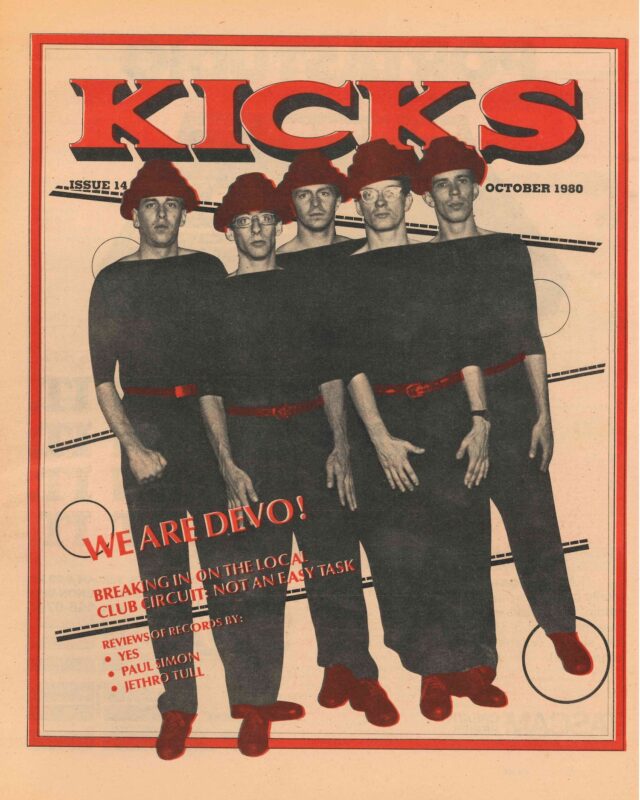
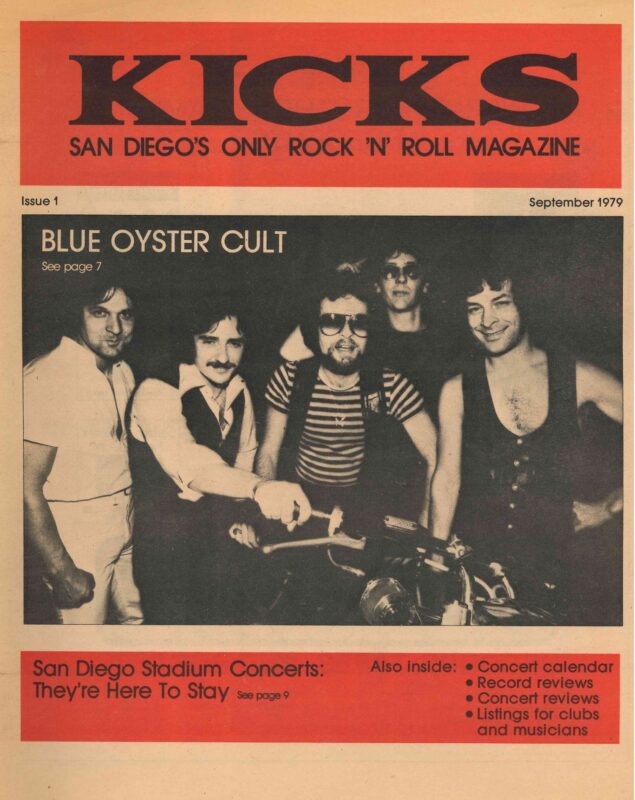
The third regional music magazine we’re featuring here is Kicks: San Diego’s Only Rock ‘n’ Roll Magazine. Kicks ran for 19 issues over 2 years and was founded and edited by Thomas K. Arnold and Albert Carrasco, both students at the time at San Diego State University. While still in high school, Arnold started writing a music column for his school newspaper, coinciding with the rise of punk and new wave music. In a 2015 interview, Arnold said, “Through my writing, I was able to get on PR lists for a number of different record companies. I still remember getting the first Ramones album in the mail and hearing the Stranglers for the first time…And then things started happening in San Diego…Hearing these wild sounds and seeing all of these people was a real awakening for me…it really started taking off in San Diego in the late ’70s. I saw a magazine called BAM – Bay Area Music up in San Francisco, and I decided that I could do this here in San Diego.” Kicks covered small local bands alongside bigger mainstream names such as Blue Oyster Cult, the Penetrators, Pat Benatar, Jefferson Starship, Black Sabbath, Devo, The Ramones, Gary Numan, the Firesign Theatre, Black Russian, and others. The issues are full of concert and record reviews, many of which were written by noted rock critic Steve Esmedina, who was known for his scathing reviews which panned Iggy Pop, Paul McCartney, Queen, and others. Issue 17 from January 1981 also features a full-page eulogy for John Lennon. (53423) $2,750
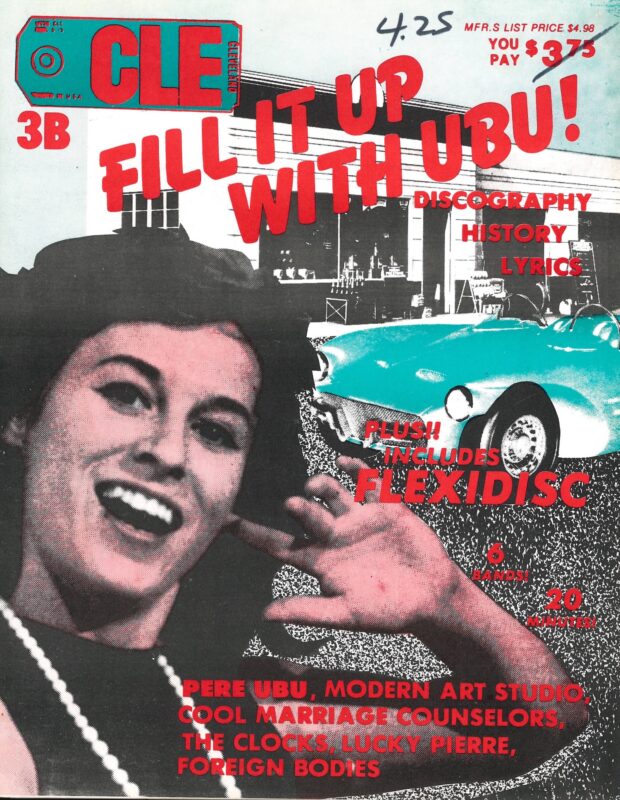
 

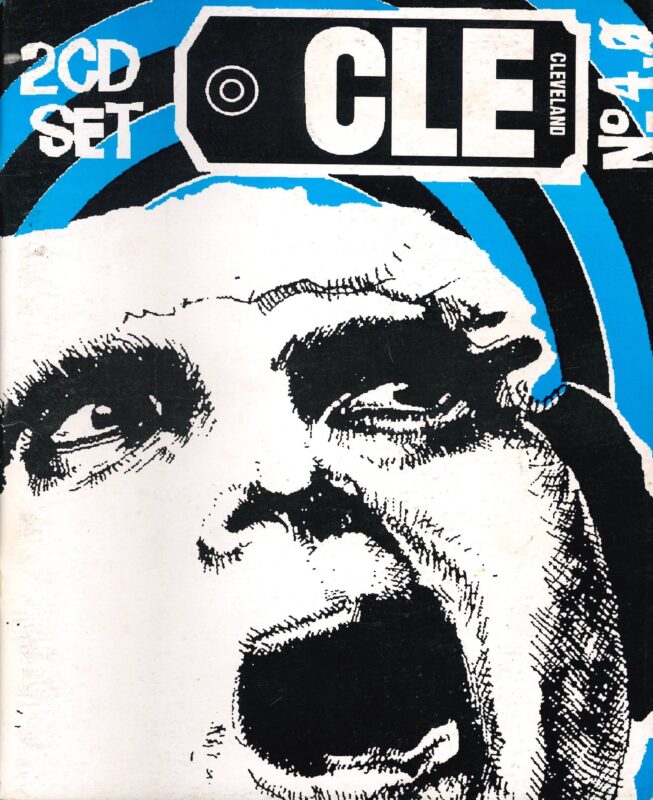
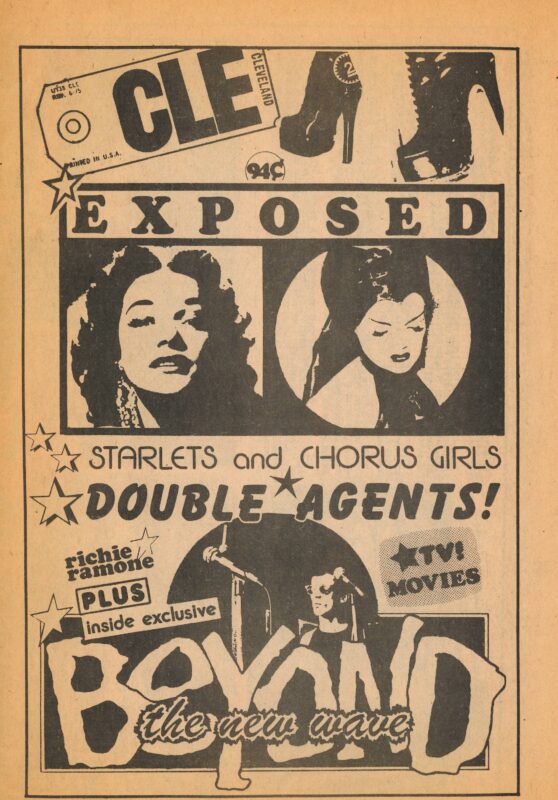
CLE was an irregularly-published and unconventional punk magazine out of Cleveland, which ran for only 8 issues over 20 years, including some CDs and one flexi-disc. The first 5 issues were published between 1977 and 1981, at which point the magazine took a 15-year hiatus before putting out the last three issues in 1996 and 1997. The magazine was founded and edited by Jim Ellis, a Cleveland-based musician and publisher. According to the website ClePunk.com, “No city’s formative punk years were complete without its own zine. In the truly underground happenings of the mid to late 70s, a local scene needed the kid who was into it enough to take and gather some photos, write some reviews, interview some bands, throw in some humor, and just as importantly have the strength to persevere and see it through to completion…Here in Cleveland it was CLE magazine.” Ellis had only planned on putting out a single issue, but people began to seek out the magazine and so he continued publishing. The issues contain features and interviews with bands such as Devo, the Electric Eels, The Residents, The Pagans, Throbbing Gristle, Urban Sax, The Outsiders, Johnny and the Dicks, The Wild Giraffes, Tin Huey, Pere Ubu, Destroy All Monsters, and others. They are accompanied by the original CDs and flexi-disc. (53424) $2,850


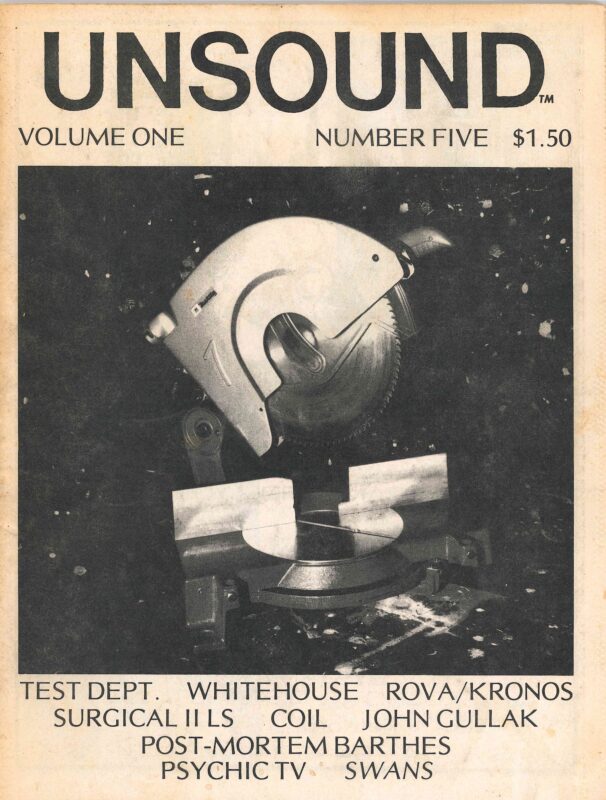
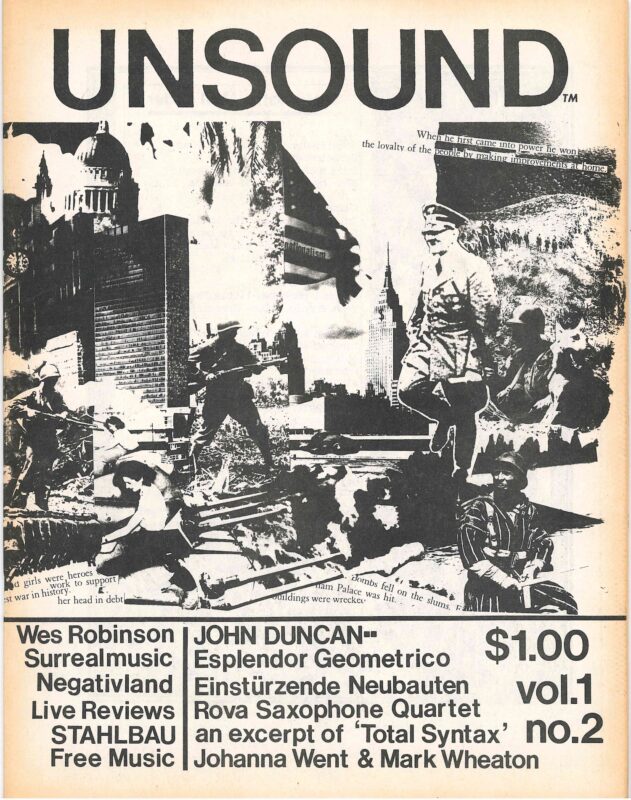
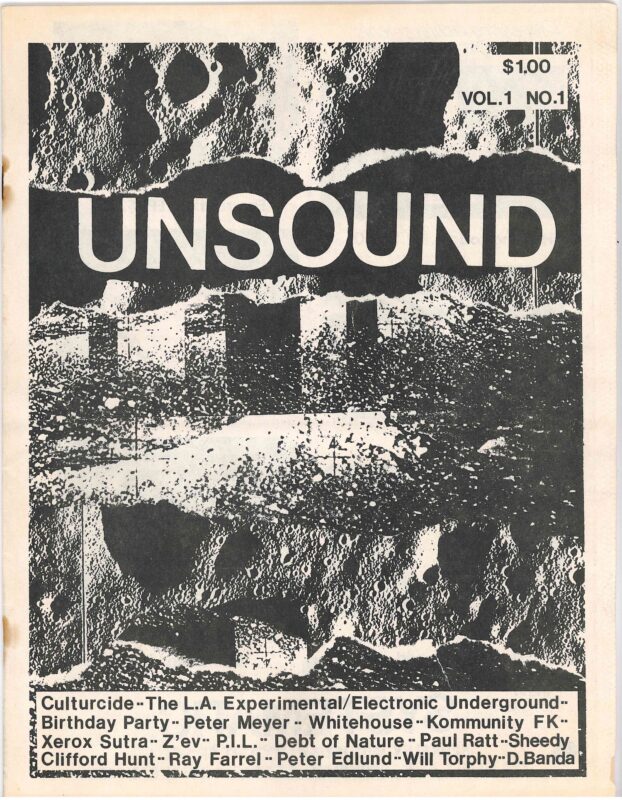
Unsound is a little bit different than the previous magazines. Published in the mid-1980s, this legendary Bay Area magazine focused on industrial sound art and experimental music. It was founded by William Davenport, a documentary filmmaker, writer, teacher, and member of the experimental noise band Problemist. According to an online article about the zine, Unsound “focused on the first wave of industrial music but covered a wide range of experimental, post-no wave music as well…Most of the issues of Unsound concentrated on artist interviews and cassette reviews, but a notable standout feature of the periodical was the detailed discographies of the artists covered therein – during a time of rampant EPs and tape-swapping, useful information indeed as well as hard to compile.” Unsound extensively documented the blurring boundaries between avant-garde performance and sound art, DIY home recordings, and the Industrial music scenes of North America and Europe during the mid-1980s. It was also an important networking tool, with sections devoted to radio, other zines, record stores, mail art, and reviews. Some of the artists featured included Sonic Youth, White House, Glenn Branca, Culturcide, Nurse With Wound, Psychic TV, Test Dept., David Tibet, Swans, and others. (53362) $2,500


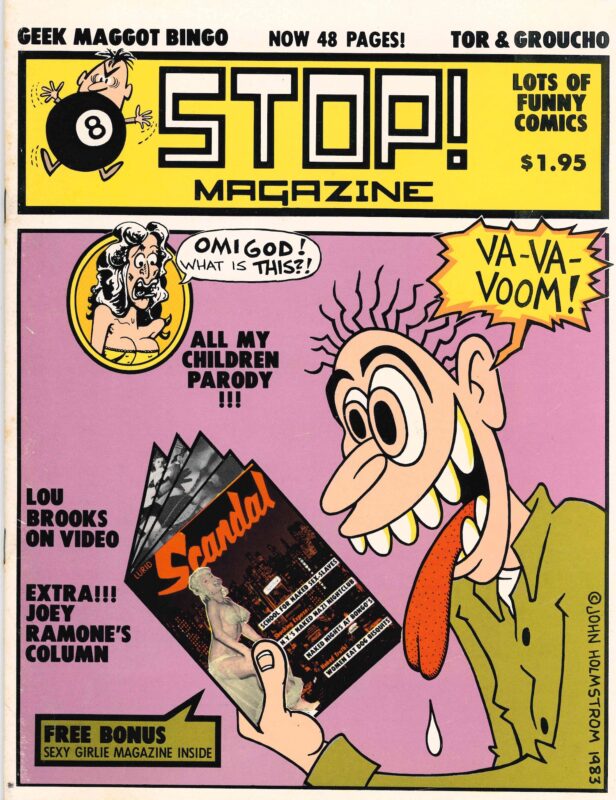
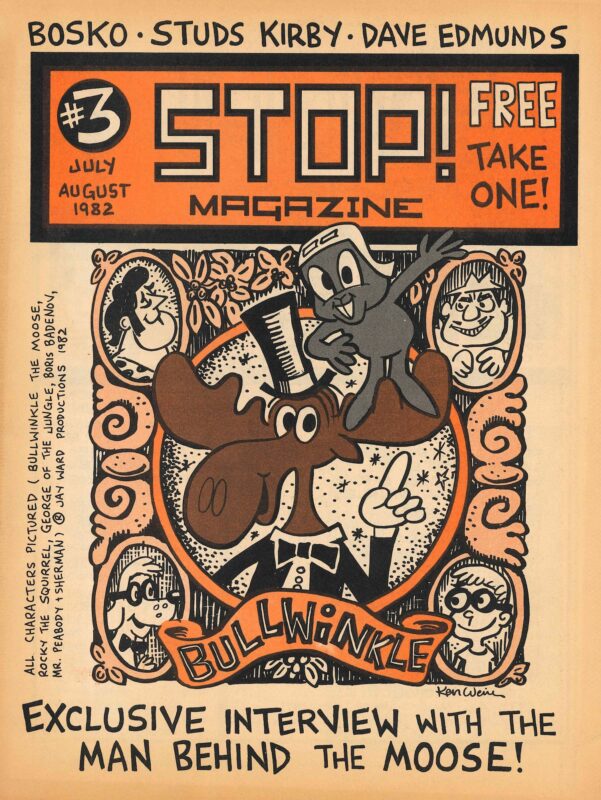
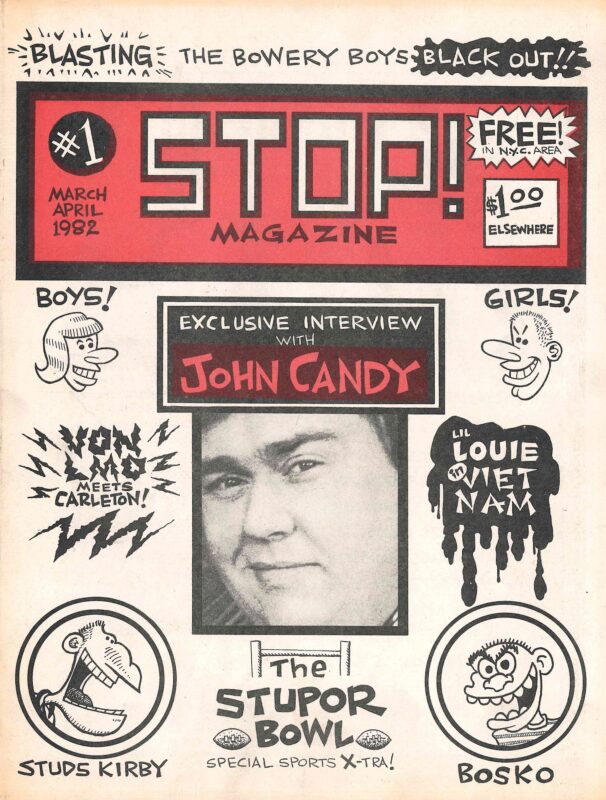
Stop was a punk and underground pop culture and humor magazine out of New York City, published in the early 1980s. Co-edited by former Punk publisher John Holmstrom and J.D. King, the magazine covered underground music, pop culture, and slapstick humor, with features such as satirical articles, interviews with icons such as John Candy, Joey Ramone, and Soupy Sales, and comics by several of the era’s defining underground comics artists. The magazine as a whole demonstrated New York punk’s affinity for slapstick comedy and shock humor. It ran for 9 issues over 3 years. (53393) $2,500


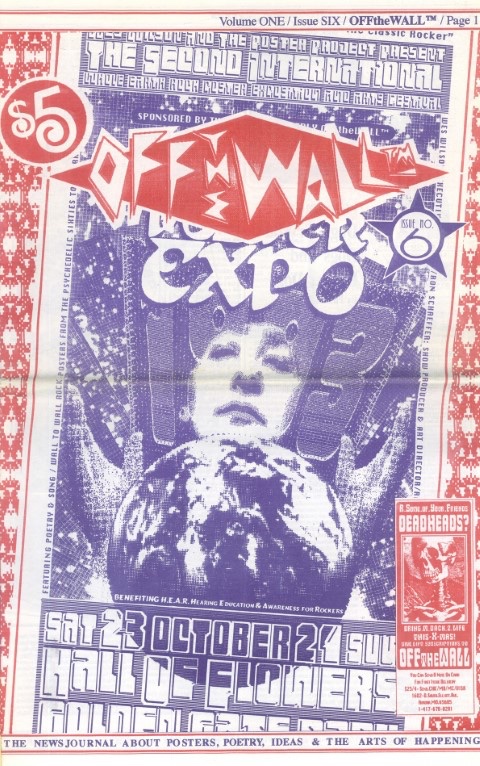
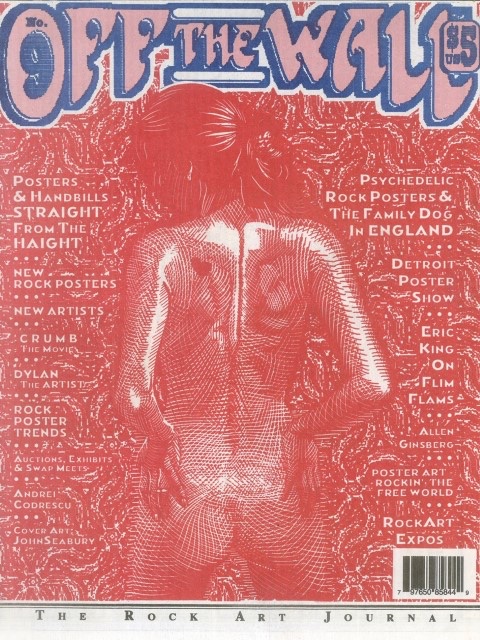
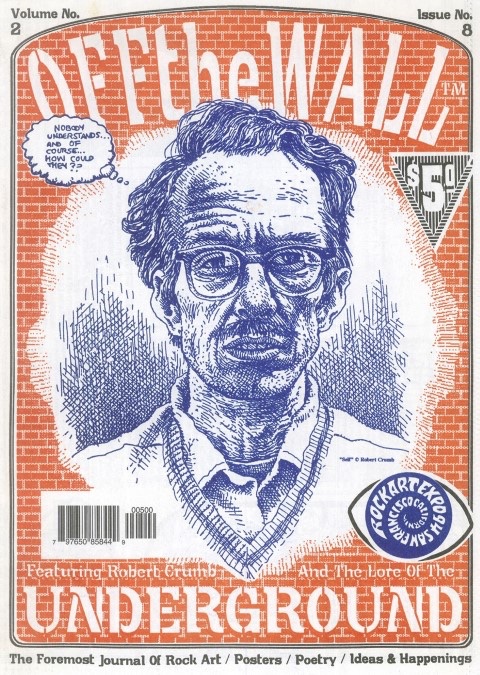
The last magazine in this collection is Off the Wallan irregularly-published magazine dedicated to the art of psychedelic rock posters and underground comics. Over the four years of its publication, the magazine carried various subtitles, including “The Newsletter Journal for Event Posters and the Arts of Happenings” and “The Foremost Journal of Rock Art/Posters/Poetry/Ideas & Happenings”. The magazine was edited by noted American artist and psychedelic poster designer Wes Wilson, and the issues contained contributions from artists such as Robert Crumb, Andrei Codrescu, Eric King, Gary Grimshaw, Walter Medeiros, Ben Edmonds, John Platt, Dick Wentworth, and others. There are also reproductions of posters as well as original photographs and comics. The artwork was all executed in an experimental computer graphic page design. Off the Wall also provided a linkage between the left-wing political commitments of the psychedelic era and the more diffuse drug culture and music scenes of the nineties. (53411) $5,000

{ 0 comments }

The Spanish Civil War was a period of great political turmoil and upheaval in Spain. The war broke out on July 17, 1936, when a conservative military group led by the generals Emilio Mola and Francisco Franco tried to overthrow the country’s democratically-elected republican government. Political and social tensions had been building in Spain for years prior to the actual revolt.

The military rebels expected an easy win and were surprised to encounter a huge popular resistance, especially in more densely populated areas. In a very short time, Spain was split in half, with one zone controlled by the government, or the Republicans, and the other by rebels, known as the Nationalists. Three years of bloodshed and fighting followed. General Franco quickly emerged as the commander of the Nationalist side, facing the Republican leaders of President Azaña, Prime Minister Largo Caballero, and Prime Minister Negrín. The war eventually ended with a Nationalist victory on April 1, 1939, with an estimate 500,000 and Franco would rule Spain as dictator until his death in 1975.

Not surprisingly, numerous books, pamphlets, and periodicals were published during the war, covering both sides of the conflict in real time, as well as international observations on the war and statements of solidarity and sympathy with one side or the other. Here at Bernett Rare Books, we currently have a collection of Spanish Civil War publications which reflect both the Republican and Nationalist sides of the struggle, as well as international sympathies with and coverage of the war. The following three titles were all published in Spain during the war:

    Gómez Aparicio, Pedro. ¡A Bilbao! Estampas de la Guerra en Vizcaya. Granada: Librería Prieto (Ediciones Imperio), 1937. Octavo (17.5 x 12.2 cm). Original color printed wrappers; 354 pp., illustrated. Some light wear and soiling to covers, mild browning to pages, overall very good. (52999) $1,750


The first edition of the work by the Spanish journalist Pedro Gómez Aparicio (1903-1983). Born in Madrid, Aparicio served as the President of the Asociación de la Prensa de Madrid, served as deputy director of the Agencia EFE, and was awarded several prizes and medals for his work. He served as editor-in-chief of the newspaper El Debate, of the magazine Mundo, and was the founder and first director of the Granada-based newspaper El Ideal. He also worked as a professor of journalism and was awarded a Medalla al Mérito en el Trabajo personally by Franco. During the first two decades of Francoism, Aparicio was given his own radio commentary show on Radio Nacional de España, which was broadcast together with the news report. He was popularly known as “Pedrogo”. Prior to these years, during the Second Republic, he was an outspoken critic of the regime, which caused him to come up against issues of censorship. When the war broke out, he moved to Burgos and served as a war correspondent for the rebel troops.

This volume is dedicated to General Franco and all of those who fight, and sets out to cover the campaign in the north of Spain. It is divided into sixteen chapters laid out in a table of contents at the back. There are scattered laid-in illustrations from photographs of soldiers and civilians, and one fold-out map with tissue paper overlay showing the March 30th offensive.


ABC. Diario Ilustrado. Edición de Andalucia. No. 10340 (18 Julio 1936) through No. 11181 (2 Abril 1939). Approximately 841 issues total bound in 32 volumes of the Seville edition of the long-running conservative Catholic and monarchist Spanish journal, covering the period of the Spanish Civil War, being the majority of years XXXII through XXXV of the journal’s publication, with 5 volumes for 1936, 12 each for 1937 and 1938, and 3 for 1939. Quarto (12 1/2 x 9 1/4 inches). Cloth-backed boards with gilt-stamped title, month, and year to spine. Light rubbing and abrasions to covers, some light scattered toning and foxing to interior, overall very good. Sevilla, 1936-1939. (53365) $15,000

ABC was founded in Madrid in January 1903 by Torcuato Luca de Tena y Álvarez-Ossorio and published by Prensa Española, and in October of 1929 the Seville edition began publication. Over the years, 11 different editions have existed, although Madrid and Seville are the primary two.

Shortly after the outbreak of the Spanish Civl War, ABC Madrid was seized by the republican government, and the newspaper changed its politics to support the Republicans. ABC Sevilla, on the other hand, was supportive of the Nationalists. After the war ended, ABC Madrid was given back to its original owners by Franco, under whom ABC became the best-selling newspaper in Spain. As late as 2005, it was still the third-best-selling newspaper in Spain, and the oldest in Madrid. Publication continues to this day. Many of the issues have bold photographic or illustrated covers, some with photocollage, while many of the later issues have very few or no illustrations. An important publication providing a Nationalist perspective from the critical years of the Spanish Civil War. Scarce institutionally.


SRI: El Camino de la Solidaridad. Unpaginated [40 pp.] magazine published during the Spanish Civil War by the Socorro Rojo Internacional (SRI, or International Red Aid), profusely illustrated. Small tabloid (14 1/2 x 10 5/8 inches). Original photomontage illustrated saddle-stitched wrappers. “Numero Gratuito” rubber-stamped to top of front cover, some light edgewear and minor chipping, crease along horizontal fold, light dust-staining to margins, overall very good. Madrid: Editorial Estampa, 1937. (53505) $1,500

This scarce Spanish-language magazine was a one-off publication, issued just six months after the start of the Spanish Civil War. It was published on behalf of the SRI (Socorro Rojo Internacional, or International Red Aid), a Spanish-Soviet organization formed by the Comintern, or Communist International, in 1922. The SRI was created to function as a sort of international Red Cross, independent of any religious organization, and in Spain was mostly involved in aid activities in the Republican zone, such as creating and running refugee camps, soup kitchens, libraries for soldiers, mobilization of dentists to the front, organization of charity drives for food and clothing, transportation networks between hospitals and the front, and the repurposing of various buildings into field hospitals, blood banks, and makeshift schools. Many of their activities had children as a central focus. (The Visual Front: Posters of the Spanish Civil War from UCSD’s Southworth Collection, 1998)

This publication highlights the SRI’s involvement in relief efforts. There are photo essays regarding sanitation work, the establishment of blood banks in Madrid and the provinces, dentistry work, the establishment of schools and children’s homes, refugees, and even reproductions of propaganda. There are many images which show the human cost of war, especially women and children affected by the fighting. The front cover features a photomontage designed by Spanish artist and graphic designer Ricardo Yesares Blanco, who signed his works “YES”. Scarce institutionally; as of June 2025, OCLC locates only two physical holdings at North American institutions.


Additionally, we have in our inventory two important publications from abroad, covering the war in great detail. The first of these was published in Paris for much of the duration of the war. Occident: Le Bi-Mensuel Franco-Espagnol. Year I, no. 1 (25 October 1937) through Year II, no. 39 (30 May 1939) (all published). Paris: Imprimerie Georges Lang, 1937-1939. Folio (58.5 x 38.5 cm). 1/2 leather with marbled boards, original illustrated newsprint self-wrappers bound in; each issue approximately 8 pp. Evidence of previous folds, some light abrasions and edgewear to boards, minor splitting to leather along spine, very minor toning, overall very good. (50048) $8,500


A complete run of all 39 issues of the Paris-based periodical, in tabloid format, dedicated to the solidarity of the French and Spanish people during the Spanish Civil War. This cultural journal contains articles by noted international cultural figures on various aspects of the war, Spanish culture, French interests in Spain, and other subjects, and is profusely illustrated throughout after photographs, caricatures, political cartoons, reproductions of posters, etc.

The fourth issue contains the “Manifest aux intellectuels espagnols”, a manifesto in support of General Franco and Franco’s Spanish intellectuals, signed by intellectuals from various right-wing factions. The scarce serial presents a compendium of in-depth articles and political analysis, but is perhaps most impressive for its rich trove of visually arresting images, with many photographs showing the destruction wrought during the war.


The second is a two-volume set issued by a prominent Soviet writer, journalist, and revolutionary. Ehrenburg, Ilya. (Erenburg, Il’ia.). Ispaniia. 2 volumes (102, 151 pp.), subtitled “UHP – Do 18 Iiulia 1936 Goda” (Until July 18, 1936) and “No Pasaran! – Grazhdanskaia Voina, Iiul’-Dekabr'” (The Civil War, July-December), profusely illustrated throughout. Large quarto (12 1/8 x 8 7/8 inches). Original embossed cloth, volume 2 with mounted title illustration. Some light rubbing and minor soiling to clovers, cover illustration to volume 2 slightly browned and rubbed, light toning and foxing throughout, a few spots of minor marginal damp-staining, first volume with handwritten inscription to front flyleaf, overall very good. Moscow and Leningrad: IZOGIZ/State Publishing House for Fine Arts, 1937. (53443) $8,500

Ilya Ehrenburg (1891-1967) was a prolific Soviet writer, journalist, translator, revolutionary, and prominent member of the Jewish Anti-Fascist Committee, who became first known for his reporting during WWI, WWII, and the Spanish Civil War. During the Spanish Civil War, he became directly involved in the military activities of the Republican camp and often accompanied the Republican army as a reporter for the newspaper Izvestiya. He was also frequently allowed by Stalin to visit Europe to help campaign for peace and socialism.

These two volumes together comprise a pictorial history of the Spanish Civil War, devoted to the Spanish people’s struggle for independence. Each volume contains numerous black-and-white journalistic photographs and illustrations depicting daily village life, families, soldiers, meetings and gatherings, propaganda, war damage, with some graphic images of the dead and wounded. Each of the images is captioned in Cyrillic, many with paragraphs of descriptive text. There are several photographs by noted photographers such as Eli Lotar, Robert Capa, Oples, Reisner, and Chim (David Seymour). Alongside the photographs, the second volume also contains a John Hartfield photomontage and reproductions of numerous political posters. The covers of Volume 1 were designed by Eugene Golyahovsky, and Volume 2 was designed by El Lissitzky and Sophie Lissitzky-Küppers. Scarce institutionally.

{ 1 comment }

The History of Horse Doping

May 17, 2021

News stories have been swirling in recent days regarding the winner of the most recent Kentucky Derby, Medina Spirit. Following the race, Medina Spirit failed an initial drug test with his blood testing positive for betamethasone, an anti-inflammatory drug. The horse’s trainer has since acknowledged that the horse was treated with an anti-fungal ointment which […]

The Hospital Train in World War I Germany

April 2, 2020

A recent news story out of France reported that the French national railroad system had converted a high-speed TGV train into a hospital train, to move COVID-19 patients from Strasbourg to less stressed hospitals in the Loire Valley. The first usage of mass transportation to evacuate and treat the wounded happened in the 1850s during […]

The Erotic Imagination of Hans Bellmer

September 24, 2018

Hans Bellmer was a Surrealist German artist and photographer. Born in 1902 and initially working in the fields of advertising and graphic design before transitioning to fine art, Bellmer’s first major project was also one of his best-known – Die Puppe, or a group of life-sized and sexualized pubescent female dolls. The goal of this first […]

The Political Photomontages of John Heartfield

August 1, 2018

John Heartfield (born Helmut Herzfeld) was an important and ground-breaking artist in Germany, known as the inventor of photomontage. He anglicized his name in protest against the anti-British sentiments prevalent in Germany after the First World War. He was a member of Berlin Club Dada, later assisting with the Erste International Dada-Messe exhibition of 1920. […]

“Il est interdit d’interdire! (It is forbidden to forbid)”: The Protests That Defined a Generation

May 16, 2018

This month marks the 50th anniversary of the massive strikes and demonstrations held in Paris and across France in May 1968. To this day, “May 68” is considered to be a cultural, social, and moral turning point in the history of France, and the events of that time had a resounding impact which was felt […]

“By Any Means Necessary”: Black Power and the Rise of the Black Panther Party

May 2, 2018

The 1960s were a tumultuous time in history, both in the United States and around the world. The 1960s saw the Bay of Pigs, the assassinations of John F. Kennedy and Dr. Martin Luther King Jr., important strides in the Civil Rights Movement including the Greensboro sit-in and the Selma-to-Montgomery march, student protests and demonstrations, […]

Iron and Ice: The Battle of Kil-Bouroun in Crimea

April 4, 2018

The Crimean War broke out on October 16, 1853 and lasted until early 1856, and was fought initially over the rights of Christian minorities in the Holy Land, which was under the domain of the Ottoman Empire. On one side was the Ottoman Empire allied with Britain, Sardinia, and France, who favored the rights of […]

Divination and Cartomancy: An Impressive Collection of Tarot Cards

July 19, 2017

The history of tarot is long, and probably surprising to some. The earliest known surviving full deck dates to the early 15th century in Italy. Painted by Bonifacio Bembo for the Duke of Milan, it is known as the Visconti-Sforza deck, after the Duke’s family name. In Renaissance Europe, these decks of cards, then known […]

Historical and Documentary Photography in 19th and Early 20th Century America

May 31, 2017

The late 19th and early 20th centuries were periods of major change and important historical events throughout the United States, as well as key developments in photography technology. Life could be documented in a way that was never possible before, both physically and economically. Photography allowed for more precise archiving than either lithography or engraving. […]

Breaking Gender Barriers: Women and the WPA Milwaukee Handicraft Project

April 27, 2017

The Works Progress Administration (WPA) was the largest and most ambitious agency created by the United States government as part of the New Deal, established under President Franklin Delano Roosevelt to help combat the Great Depression, focusing on the “3 Rs” of Relief, Recovery, and Reform: relief for the poor and unemployed, recovery of the […]

Printer’s Archive for the Official Program of the Democratic National Convention of 1936.

June 30, 2016

A complete archive of the original artwork, photographs, advertisements, and fully edited and corrected typewritten essays which comprise the official guide to the 1936 Democratic National Convention, held in Philadelphia: including 41 original pen and ink drawings by Lyle Justis used as vignettes and illustrations throughout the text; over 200 original photographs, most with identification […]

A Collection of Leftist Political Posters, 1960-2010

April 15, 2016

Cuba, OSPAAAL (Organization of Solidarity with the People of Asia, Africa, and Latin America), 1971 and 1972  Extensive and Culturally Significant Archive of Approximately 500 Political Posters. An important, unique, and carefully curated collection of political posters, dated from approximately the 1960s to the 2000s, from a wide variety of leftist and militant groups in […]

Le Bal des Quat’z’ Arts: Revelry and Debauchery in Turn of the Century Paris

September 8, 2015

“It is a riot, a revival of paganism…It is also, in its way, a hymn to beauty, a living explosion of the senses and of the emotions.” – E. Berry Wall, Neither Past Nor Puritan In 1892, Henri Guillaume, Professor of Architecture at the École nationale supérieure des Beaux-Arts in Paris, proposed that the students […]

The École de Montmartre in 1920’s Paris

August 17, 2015

              Paris in the late 19th and early 20th century, especially during the periods known as the Belle Époque and les Années Folles, was a hotbed of intellectual and artistic life. During the former, Montmartre was abuzz with cafés, cabarets, and artists’ studios, with a large number of painters […]

Charlie Hebdo’s Ancestors

January 23, 2015

  Journalism in France has a rich tradition of political satire and caricature, dating back many hundreds of years and gaining footholds at many crucial moments in France’s history. Popular in the 17th century, Molière and Jean de la Fontaine earned their fame mocking the upper echelons of society through comic plays or fables, often […]

Anni di piombo. The Lead Years, 1968-1982.

August 11, 2014

“Anni di piombo” (“The Lead Years”) has little nostalgic resonance in the US. Unlike “Mai ‘68”, which instantly evokes exhilarating scenes of French student occupations, demonstrations, police brutality, wildcat strikes, riots, and barricades. (And perhaps some fervent threesomes if you made it through Bertolucci’s The Dreamers.) While Mai ‘68 appears retrospectively as both the unfulfilled […]

Under the Matzos Tree.

May 9, 2014

52 Examples of Jewish-American Sheet Music from the Early 20th Century. A collection of English-language sheet music, ca. 4-8 pp. each, in orig. color illus. wrrps., most published in New York, Boston, Chicago, Cleveland, or Los Angeles, ca. 1900-1920. (47699) “Under the Matzo Tree: A Ghetto Love Song,” “Yiddle on your Fiddle Play Some Rag […]